
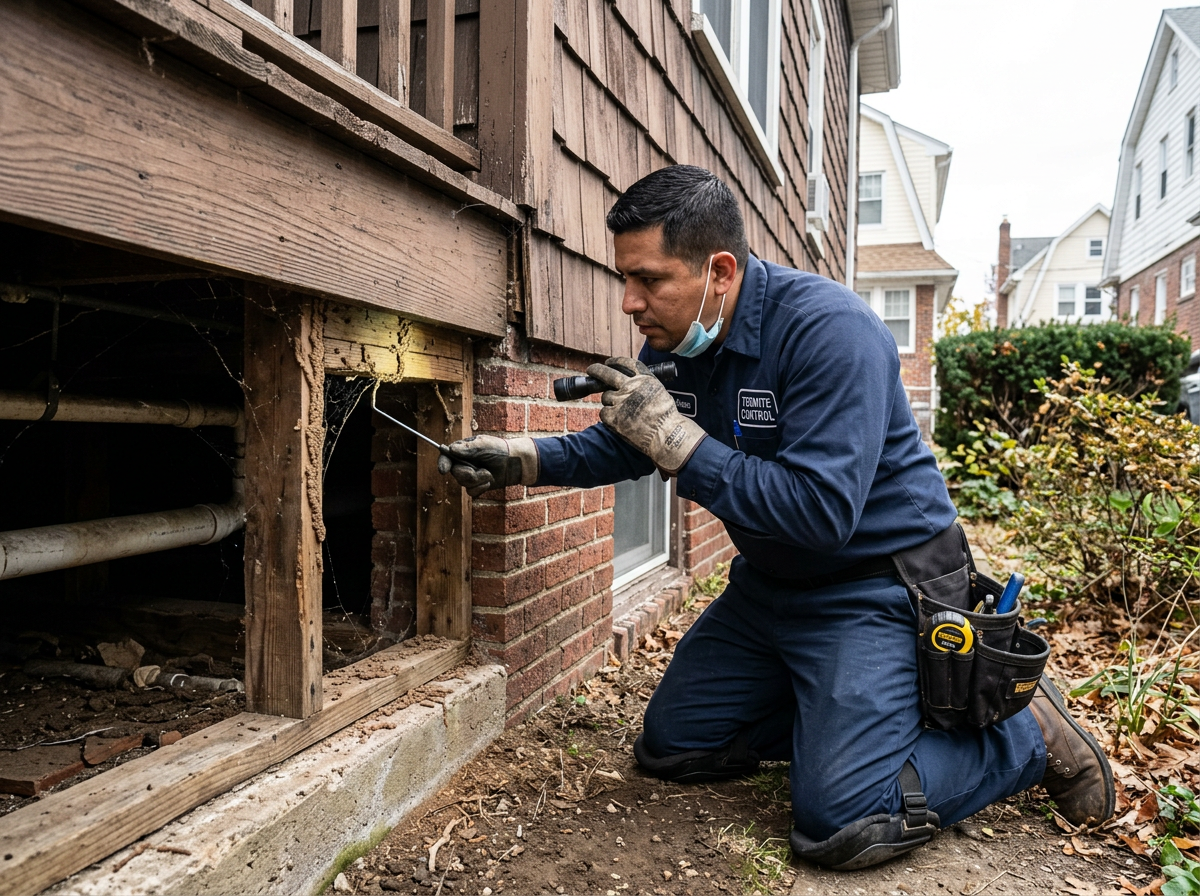
Termites move through the voids and cracks common in Hudson Valley fieldstone and rubble foundations. They follow moisture along cast-iron sewer laterals and enter via gaps where mortar has eroded or where utility lines penetrate the sill. In Thiells homes built before 1950 these paths stay hidden behind dirt floors and stacked stone, letting colonies reach framing without visible mud tubes on the exterior.
A proper inspection requires lifting floorboards in cellars, probing joists with an awl, and checking the soil-to-wood contact points that develop when grading settles against the foundation. Missed entry points behind old clay pipes or through shared walls in row houses allow reinfestation within a single season once soil temperatures rise in spring.
Termite Inspection Near You — Choose Your City
Every city below has its own local Termite Inspection page with coverage details.
Nassau
Suffolk County
Rensselaer
Dutchess County
Monroe County
Ulster
Westchester
Suffolk
Erie County
Ontario County
Erie
Nassau County
Ulster County
Dutchess
Niagara
Saratoga
Orange
Cayuga
Wyoming
Columbia County
Allegany County
Sullivan County
Queens County
Albany County
Wayne
Rockland County
Onondaga
Rockland
Warren County
Homeowners often treat only the visible tubes on the exterior while the main colony remains active in the wall voids or under the slab. Without mapping the full moisture trail and confirming live activity with a borescope or listening device, the problem simply shifts to the next unsealed gap.
New York’s freeze-thaw cycles open new cracks each winter, so annual checks after the ground thaws are the only way to catch new activity before it reaches the first-floor framing.
Technician insight
In Thiells, the thing that catches most people out with Termite Inspection is the old fieldstone foundations that let tubes travel behind the stones without ever showing on the finished side; once the dirt floor gets disturbed the colony simply moves to the next gap.
Thiells Cellar Find
Homeowner noticed small tubes along the cellar wall after spring thaw. Inspection revealed active mud tubes behind loose rubble where a cast-iron lateral had settled. We mapped the trail to two additional entry points under the sill and documented live workers with a borescope. The owner scheduled targeted follow-up work based on the mapped locations.
Termite Inspection Services We Offer
✓Subterranean Termite Inspection
Detailed check of foundation walls, sewer laterals, and soil contact points where New York colonies most often enter older homes.
✓Pre-Purchase Termite Inspection
Focused inspection for buyers that identifies active colonies and hidden damage in Thiells and Hudson Valley properties before closing.
✓Cellar and Crawlspace Termite Check
Targeted look under dirt floors and low crawlspaces where moisture and rubble foundations create ideal travel routes for termites.
✓Follow-Up Verification Visit
Post-treatment inspection that confirms colony elimination and checks previously identified entry points remain sealed.
✓Commercial Termite Inspection
Inspection program for multi-unit and mixed-use buildings that maps termite activity across shared walls and utility chases.
How it works
- 1
Initial Walkthrough
We examine the exterior grade, foundation cracks, and utility penetrations around the structure.
- 2
Interior Probing
Floorboards are lifted in cellars and joists are sounded for hidden damage along known moisture trails.
- 3
Mapping Activity
Live tubes and frass are documented and entry points are traced back to the soil or lateral lines.
- 4
Report and Recommendations
Findings are reviewed on site with clear next steps based on what was actually located.
Pricing
Scope depends on property age, foundation type, and whether crawlspaces or multiple units are involved. Call for an inspection quote.