
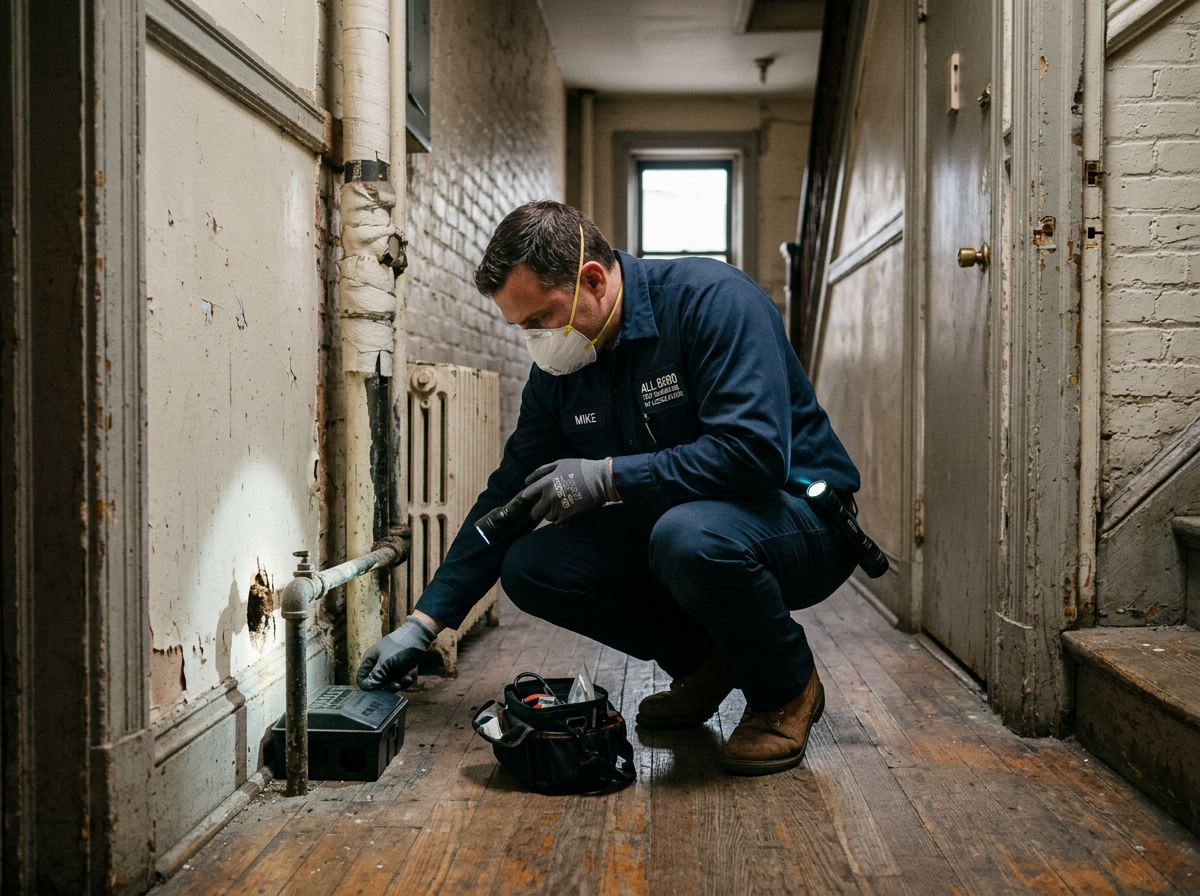
Riverhead's post-war subdivisions sit on sandy Suffolk soil that lets rodents tunnel against slabs and crawlspaces while garages and sheds provide cover before they reach living areas. Crews work from the New City base via I-495 and NY-25 to reach Downtown Riverhead, Wading River, and Aquebogue without delay.
Seasonal North Fork properties that sit empty between uses create re-entry points each spring, so inspection focuses on foundation gaps and outbuilding access that change with the Atlantic-moderated climate.
Here's how our rodent control work runs in Riverhead — the same standards we hold across New York, delivered by the crew that covers Suffolk.
Rodent Control Services We Offer in Riverhead
✓Entry-Point Exclusion and Sealing
Technicians locate and permanently close every gap around foundations, utility entries and rooflines so rodents cannot re-enter after trapping.
✓Rodent Inspection
Detailed survey of cellar, crawlspace, walls and attic to identify active runs, droppings and the exact openings used by Norway rats and house mice.
✓Interior Trapping Program
Placement of covered traps along established runways inside walls and cabinets rather than broadcast bait that rodents may avoid or carry elsewhere.
✓Exterior Bait Station Management
Anchored stations positioned against foundations and sewer laterals to reduce outdoor pressure once all indoor entry points have been sealed.
✓Follow-Up Verification Visit
Return inspection after initial work to confirm no new activity and that seals have held through the first cold snap.
✓Commercial Rodent Program
Ongoing monitoring and exclusion for multi-unit buildings where party walls allow rodents to move between neighboring properties.
In Thiells and the surrounding Hudson Valley stock, Norway rats travel along cracked clay sewer laterals and rubble foundations while house mice and roof rats move upward through wall voids, soffits and attic insulation. Fieldstone basements and party walls common in pre-war homes create continuous runs that let rodents shift between yards, cellars and living spaces once temperatures drop. A single unsealed ¼-inch gap around a utility penetration or loose mortar joint is enough for mice to re-enter nightly.
Effective work begins with a full exterior and interior inspection to map every opening, followed by steel wool, copper mesh and cementitious sealing at ground level and roofline. Interior trapping stations are placed along active runs rather than scattered bait, and exterior bait stations are anchored only after entry points are closed. Missed gaps or reliance on bait stations alone allow fresh rodents to replace those removed, especially during the September-to-November migration when snow cover pushes activity toward heated buildings.
How It Works in Riverhead
- 1
Site Inspection
Map all entry points, runways and harborage areas in foundations, walls and attics.
- 2
Exclusion Work
Seal identified gaps with appropriate materials at ground level and roofline.
- 3
Trapping and Monitoring
Install interior traps and exterior stations along confirmed travel routes.
- 4
Verification and Adjustment
Return to confirm results and repair any newly discovered openings.
Serving All of Riverhead
We regularly handle rodent control jobs near:
- 📍Riverhead Raceway
- 📍Long Island Aquarium
- 📍Suffolk County Historical Society
Rodent Control Pricing in Riverhead
Scope is determined by the number and location of entry points discovered during inspection plus property size; call for a quote specific to your Thiells building.
Want the full picture of this service? See our Rodent Control page, or everything we do in Riverhead, NY.